
Comparing Translation Business Management Systems
09. 06. 20264 min to read
Every translation company eventually outgrows spreadsheets and email. A Translation Business Management System (TBMS) is the operational backbone that fixes this: it runs the full lifecycle from client request and quoting, through production and CAT‑tool handoff, to delivery, invoicing and vendor payment. A TBMS is not a CAT tool. Trados, Phrase and memoQ handle the linguistic work; a TBMS sits above them, orchestrating the business — who does what, for how much, by when, and whether the project made money. This guide focuses purely on that business‑management layer.

The contenders at a glance
Plunet and XTRF are among the older, well‑established platforms in this space — deep, configurable and aimed at larger LSPs with the budget and admin resources to match. Bureau Works is a cloud‑native platform that is working to add an AI layer across translation and management. Protemos is a lighter, more limited option focused on the essentials for smaller agencies.
Where traduno fits
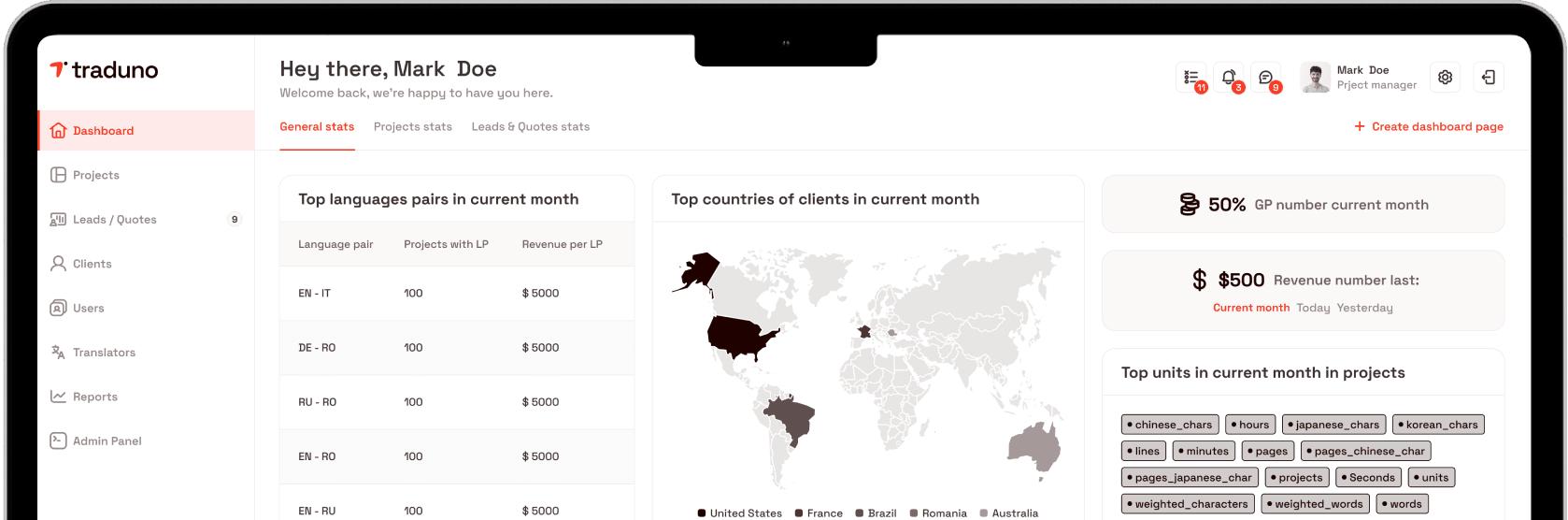
Traduno is a TBMS built by people who run real translation production at scale, and now offered to other LSPs. Because it grew out of daily operations rather than as a generic product, it leans toward how LSPs actually work — and it is designed to be highly customisable yet easy to use.
It covers the full operational core: Project Management (intake to delivery, deliverables, workflow templates), Vendor Management (linguist profiles, rate cards, assignment), Client Management (a client portal for requests and tracking), and deep Finance Management — quoting from CAT‑analysis word counts, partial and advance invoicing, prepaid workflows, and client‑ and vendor‑side credit notes. It connects to the tools LSPs rely on, integrating with Phrase (as a Phrase partner) and accounting systems including QuickBooks and NetSuite.
Beyond features, the commercial model is built to be fair: transparent pricing at $75 per seat per month with no hidden enterprise quotes, support and onboarding included rather than charged as costly add‑ons, and a client‑driven roadmap — customers directly influence what gets built next.
Feature comparison
| Capability | traduno | Plunet | XTRF | Bureau Works | Protemos |
|---|---|---|---|---|---|
| Deployment | Cloud / on‑prem | Cloud / on‑prem | Cloud / on‑prem | Cloud | Cloud |
| Quoting & CAT‑analysis pricing | Yes (Phrase partner) | Yes | Yes | Yes (AI‑assisted) | Basic |
| Vendor management & assignment | Yes, automation in progress | Yes | Yes | AI assignment | Yes |
| Finance: partial/advance invoicing, credit notes | Yes (client & vendor) | Yes | Yes | Partial | Core invoicing |
| Accounting integration | QuickBooks, NetSuite | Multiple | Multiple | Limited | Export / QuickBooks |
| Client / vendor portal | Yes / Yes | Yes / Yes | Yes / Yes | Yes / Yes | Limited / Yes |
| Multi‑brand / white‑label | Yes (native) | Limited | Limited | Limited | No |
| Pricing model | Transparent — $75 / seat / month | Enterprise quote | Enterprise quote | Subscription | Transparent per‑user, free tier |
| Support & onboarding | Included | Paid add‑on / tiered | Paid add‑on / tiered | Tiered | Self‑serve / limited |
| Roadmap influence | Client‑driven | Enterprise‑led | Enterprise‑led | Vendor‑led | Vendor‑led |
| Setup complexity | Low–moderate | High | Moderate–high | Moderate | Low |
General positioning only — verify current capabilities and pricing with each vendor.
How to choose
There's no single best TBMS, only the best fit. Larger LSPs with complex workflows and dedicated administrators are well served by the established platforms like Plunet or XTRF; Bureau Works suits teams wanting a cloud‑native tool with a growing AI layer; Protemos fits small agencies needing just the essentials.
Traduno sits in a distinctive spot: rich in features and covering the whole business — project, vendor, client and finance management end‑to‑end — while staying easy to use and backed by the best customer support, with onboarding included. It is the strong all‑round choice for teams that want full coverage without the complexity or cost of the heavier platforms. Whichever you consider, shortlist two or three, run a real project through a trial, and judge them against your own quoting, production and invoicing reality.
A note on accuracy: The information about other tools in this article is compiled from publicly available sources and reflects our understanding at the time of writing. Products evolve quickly, so details may change. If you spot anything inaccurate or out of date — especially if you represent one of the tools mentioned — please write to us and we'll be glad to correct it.
Check other material
Sub headline proposition goes here if needed